

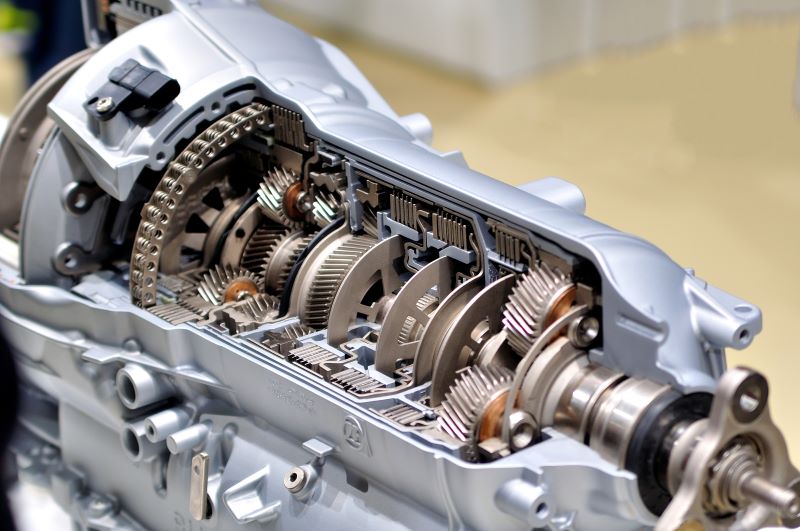
Today’s automatic transmissions are better than ever. An advanced system like a CVT transmission offers a buttery smooth transition between various gears that ensures a luxuriously supple ride feel for all passengers. Learn how the Mitsubishi CVT transmission works, how it benefits your vehicle performance, and when to book service.
Understanding the Mitsubishi CVT Transmission: Smooth and Efficient
The key to a CVT transmission is its construction. A CVT transmission is lighter in weight than a traditional automatic transmission and is commonly designed with an internal pulley system that allows the transmission to shift between high and low gear ratios seamlessly. Instead of a gearbox that locks the gear ratios, a CVT transmission can essentially swing back and forth to meet the energy demands of the engine.
CVT transmissions can also be designed around a toroidal or a hydrostatic concept. With a toroidal CVT, the gear ratios change by using an internal system of discs that rotate on two axes. A hydrostatic CVT, on the other hand, uses fluid to adjust the gear ratio. No matter the construction, as soon as you hit the gas pedal, a CVT transmission will accelerate smoothly to cruising speed and down to a complete stop.
Benefits of a CVT Transmission
The main benefit of driving a vehicle with a CVT transmission is excellent fuel efficiency. Since a CVT transmission constantly adjusts the gear ratios to find the most efficient RPM for your driving needs, your engine ends up requiring less fuel overall. Optimized fuel efficiency may be particularly important if you spend a lot of time driving in the city or suburbs.
Additionally, a CVT transmission offers a more adaptive driving experience. No matter where the road takes you, the CVT transmission in your Mitsubishi vehicle will adapt to the challenges of your driving environment, even if traveling uphill or at higher speeds requires greater RPM than cruising. For some vehicles, a CVT transmission may also offer a quieter driving experience.
When Do You Need CVT Maintenance?
Just like a regular automatic or manual transmission, you will need to visit your local Mitsubishi dealership to service your CVT transmission when you notice a change in your vehicle’s performance. For example, you may notice that your vehicle is prone to overheating or that your fuel efficiency has changed. Some drivers may even notice a burning smell from beneath the hood that could indicate severe issues with the transmission system.
The CVT transmission in your Mitsubishi is one of the reasons why your vehicle has such fantastic fuel economy. Keeping up with transmission maintenance is the best way to ensure a smooth driving experience in the future. Book your next service appointment at Music City Mitsubishi in Nashville, TN.
Connect with us


- 2024 Mitsubishi Eclipse Cross Trim Levels
- 2024 Mitsubishi EV
- 2024 Mitsubishi Hybrid
- 2024 Mitsubishi Mirage
- 2024 Mitsubishi Mirage G4
- 2024 Mitsubishi Mirage G4 Trim Levels
- 2025 Mitsubishi Eclipse Cross
- 2025 Mitsubishi Outlander
- 2025 Mitsubishi Outlander Plug-in Hybrid
- 2025 Mitsubishi Outlander Sport
- 2025 Mitsubishi Outlander vs Outlander Sport
- Madison Mitsubishi Dealer
- Madison Mitsubishi Service
- Madison Used Cars
- Mitsubishi's CVT Transmission
- Mitsubishi's Transmission
- Music City Mitsubishi
- Music City Mitsubishi Service
- Nashville Auto Loan
- Nashville Car Loan
- Nashville Cars For Sale
- Nashville Eclipse Cross
- Nashville EV SUV
- Nashville Mitsubishi Dealer
- Nashville Mitsubishi Dealership
- Nashville Mitsubishi Eclipse Cross
- Nashville Mitsubishi Hybrid SUV
- Nashville Mitsubishi Mirage
- Nashville Mitsubishi Mirage G4
- Nashville Mitsubishi Outlander
- Nashville Mitsubishi Outlander PHEV
- Nashville Mitsubishi Outlander Sport
- Nashville Mitsubishi Transmission Service
- Nashville New SUVs For Sale
- Nashville SUVs For Sale
- Nashville Transmission Service
- Nashville, TN Compact SUV
- Nashville, TN Mitsubishi Eclipse Cross
- Nashville, TN Small SUV
- New Mitsubishi Eclipse Cross
- New Mitsubishi Eclipse Cross Trim Levels
- New Mitsubishi Hybrid
- New Mitsubishi Mirage
- New Mitsubishi Mirage G4
- New Mitsubishi Outlander Features
- New Mitsubishi Outlander Plug-in Hybrid
- New Mitsubishi Outlander Sport
- New Mitsubishi Outlander Technology
- Outlander Hybrid
- Outlander PHEV